
To define sound is to impose a structurally flawed mechanism that compartmentalises music in pseudo categories that are fleeting and ephemeral. Wallflower is an eclectic combination of individuals from rather distinct backgrounds, at least musically. Five imperative members with five imperative minds constructing Wallflower from its grassroots and successfully penetrating the local indie music scene!

From left to right, Tommo (bassist), Kai Wei (lead guitarist), Tatsuki (vocalist), Hilman (rhythm guitarist), Azmil (drummer).
Wallflower began their music journey in 2020 with only two of the existing members. Multiple iterations of band names were experimented with and quite a handful of individuals took their departure from the band but ultimately Wallflower is for individuals who deviate from the norm and embrace their niche.
“The name ‘Wallflower’ made sense at the time because it literally means lonely person at a party and we mostly make music for people like that”, explained Kai Wei.
Wallflower explores mostly shoegaze, rock, and metal sounds. Exploration for artists is bounded by genre and a flee from the clutch of genre confinement appears to be a rather exhilarating and liberating experience. Wallflower navigates genre as an ephemeral concept. It is there to serve a purpose of navigation and guidance but it begins to unravel itself as soon as music exploration becomes an intimate and characteristic aspect of their work. Their music is characteristically different from many rock bands mostly due to this very concept.
“To label our music as one distinct genre is quite challenging considering that we would need to follow rather stringently to that particular style of music”, said Azmil.
The goal is to create something unlabelled, recognizable, and indescribable all at the same time, and the process of executing this is to be perceptive to amalgamating inspirations drawn from different artists of polarising genres. Intentional collaboration and collective effervescence paves for the ritualistic experience of transforming a– at first– trivial idea into a track that is reminiscent of shoegaze and metal as a genre. It is the work of aligning this initial idea to allow it to prosper into a piece that is representative of everyone in Wallflower.
This ritualistic process is impulsive and erratic. Often starting with merely one rift and ending with original music. Three original tracks– Kids Under Cars, Sublime, and GC– being subjected to this line of development and we experience a rapture of artistry. It was this exact impulsivity that allowed Wallflower’s music to remain raw and to revel in music that is complete without the constant embellishment. This rightful impulsivity can clearly be experienced when tuning into Kids Under Cars that begins quite “groovy” and makes its slow ascent into what seems and feels like someone speeding through a highway and subsequently blowing an Aztec death whistle, construed as either “children screaming or tires screeching”.

Wallflower’s fairly recent track GC, seems to be more conceptual and serves as an abbreviation to “Glass Condom”. It is a metaphorical translation of overthinking, specifically the plague of over analysing a rather trivial matter and blowing it up in our heads.
“GC is short for Glass Condom because it’s sort of like a metaphor for overthinking. When you’re in an intimate relationship and you’re constantly overthinking, the metaphorical glass condom begins to shatter inside of your partner which then hurts not only you, but your partner as well”, explained Tatsuki.
The idea of rock music is the brutal raw honesty that comes with the head-banging guitar riffs and drum solos. It is a mutualistic effort between the lyrics enforcing emotion and the sound supporting that emotion. On stage, the emotion is prevalent in ways that transcends the stereotypical and normative need of stage presence. Wallflower could pretty much stand idly on stage and yet, the music speaks for itself through the longitudinal sound waves escaping the speakers.
Performing on stage is for the most part, feeding off of the audience’s energy and excitement. Kai Wei explained that putting on the best performance of their lives would not mean much if the audience were not receptive. A ‘bad’ show with accidental sloppy playing would do well if only the audience were receptive enough to feed into this symbiotic relationship established between Wallflower and their audience.
“It’s truly an amazing feeling to just witness random people we don’t know jumping to our music, it really gets your adrenaline going”, mentioned Kai Wei.
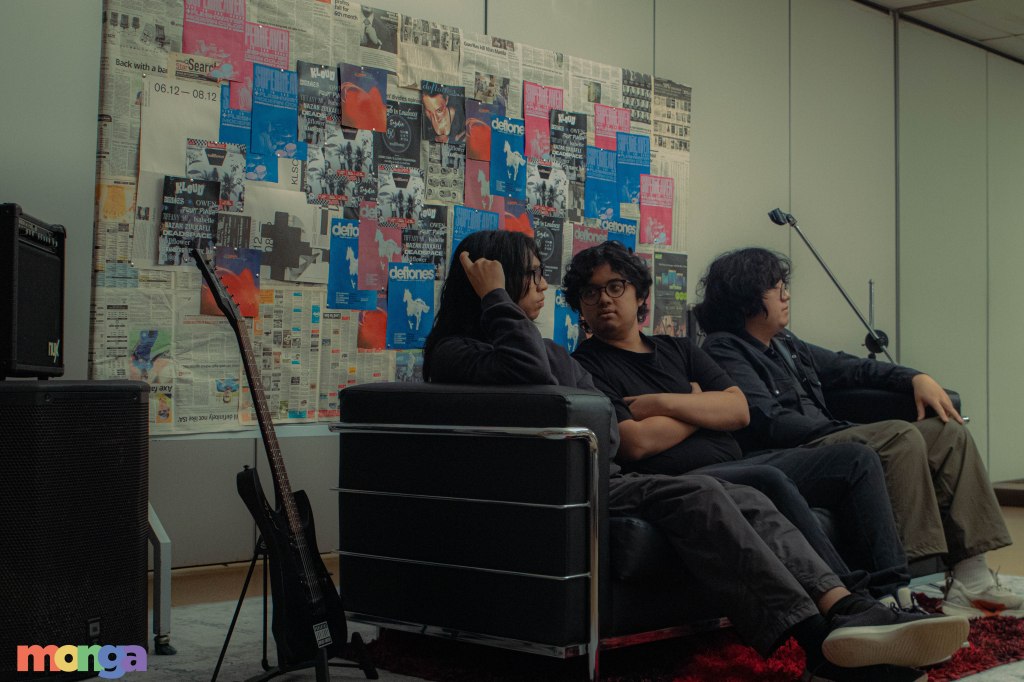
Being an artist in Malaysia and having to venture into the indie music scene yourself is a rather daunting experience. However, this was not something that held Wallflower back. It’s certainly incredibly different from the idealised and perhaps, romanticised version of being a musician and the Malaysian indie music scene is definitely different than scenes in the global north but Wallflower remained joyous. They are comfortable with the idea of potentially not going massive and gaining sufficient popularity, and this contentment is reflected in their music rather explicitly. The goal is to simply have people listen to their music in hopes that some of them resonate with their work.
Written by Yashven Jayabalan
Interviewed by Celeste
Photos by Dinya Wijeratne
 musamonga.com